What do you get?
We’re offering a lucky winner the chance to spend a 1 to 3 month (depending on your availability) all expenses paid stint living and working with animals at the Shamwari Game Reserve, this summer.
What do we want in return?
For you to become the voice of the animals. As the Voice of Conservation at Shamwari, you will spread the word about the conservation issues facing the animals you work with, from rhino poaching to big cat rehabilitation, as well as sharing all your amazing adventures. The possibilities are endless – it’s up to you to amaze us!
Our first Voice of Conservation, Karra Rothery, spread the word on our blog and her own blog, on Facebook communities and numerous forums, by writing thought-provoking posts, interviewing people like famous author and conservationist Lawrence Anthony, creating fun videos and taking loads of photos.
Showing posts with label Other Conservation. Show all posts
Showing posts with label Other Conservation. Show all posts
Wednesday, March 16, 2011
Competition: Become the Voice of Conservation at Shamwari in South Africa
The Community Coordinator at Worldwide Experience.com sent me this information on a once-in-a-lifetime opportunity to become the "Voice of Conservation" at Shamwari in South Africa this summer.

Wednesday, February 11, 2009
Extinct Ibex Cloned
The Pyrenean Ibex, a Spanish mountain goat, was confirmed as extinct in 2000. Scientists had the foresight to store its DNA in skin samples, preserved in liquid nitrogen, and now there's been the news that scientists were able to clone a baby Ibex by replacing the DNA in a domestic goat egg. Unfortunately the baby died because of lung complications.
This raises the possibility (if ever so slightly), of being able to resurrect other extinct animals.
This raises the possibility (if ever so slightly), of being able to resurrect other extinct animals.
However, attempts to revive species like the woolly mammoths and the Dodo are burdened with problems. DNA decays as time passes and creates gaps in the genetic codes needed to produce clones.
Last year, scientists released an almost-complete genome of the woolly mammoth, creating gossip that it will be possible to synthesize the DNA.
Professor Robert Miller, director the Medical Research Council's Reproductive Sciences Unit at Edinburgh University, is collaborating with the Royal Zoological Society of Scotland on cloning extraordinary African mammals like the white rhino.
Friday, July 06, 2007
COOL!! Jenson Button's F1 car now displaying our website URL
You may recall that back in February I made the pledge to replace at least three regular lightbulbs in my house to the more energy efficient kind (which I have now done). To make my donation I visited Honda F1's 'Earth Car' site at www.myearthdream.com.
It's taken Honda a while, but since last week's French Grand Prix at Magny Cours, all the names are on the cars, and perhaps we can take partial credit for Jenson scoring his first point of the season(?).
Most amazing of all, (and MANY thanks to eagle-eyed viewer Garry Mills for this) we can now actually SEE the evidence in close-up! This screenshot was snagged by Garry while it displayed last week's French GP Qualifying session results. Click on the image to get a much closer look, where I've actually hyperlinked some of the other visible URLs. Gotta love the HenCam!

This is where the Another Chance To See entry is actually located...

Good luck to Jenson Button and the HondaF1 team in this weekend's British Grand Prix, and also to McLaren's Lewis Hamilton up at the sharp-end! He's doing an amazing job right now, and I'm sure Silverstone will be sold-out this weekend as a result.
It's taken Honda a while, but since last week's French Grand Prix at Magny Cours, all the names are on the cars, and perhaps we can take partial credit for Jenson scoring his first point of the season(?).
Most amazing of all, (and MANY thanks to eagle-eyed viewer Garry Mills for this) we can now actually SEE the evidence in close-up! This screenshot was snagged by Garry while it displayed last week's French GP Qualifying session results. Click on the image to get a much closer look, where I've actually hyperlinked some of the other visible URLs. Gotta love the HenCam!
This is where the Another Chance To See entry is actually located...
Good luck to Jenson Button and the HondaF1 team in this weekend's British Grand Prix, and also to McLaren's Lewis Hamilton up at the sharp-end! He's doing an amazing job right now, and I'm sure Silverstone will be sold-out this weekend as a result.
Friday, June 08, 2007
Inbox clearout
Time to clear out a few links that have been cluttering up my Inbox and RSS feeds for a while, and I just haven't had time to post them.
Dr. Mike Cranfield on Mountain Gorilla welfare
Daycare for a dragon
Herald Petrol turns up on Round Island
Virgin Shark gives birth (Another example of parthenogenesis)
Dr. Mike Cranfield on Mountain Gorilla welfare
“One of the most incredible things about gorillas, I’ve found, is that they have, like, long, sustained flatulence that never ceases to amaze everybody that is there,” Cranfield explains.Shedd Aquarium Komodo Dragon exhibition extended through Summer 2008
“I mean, tourists are just like . . . ” he trails off, mimicking a wide-eyed, slack-jawed tourist. “Sometimes you will hear them before you see them.”
Daycare for a dragon
Herald Petrol turns up on Round Island
Virgin Shark gives birth (Another example of parthenogenesis)
Monday, April 23, 2007
Endangered animals on the EDGE
The John Hopkins Newsletter has late coverage of the 100 endangered animals on the "Evolutionarily Distinct and Globally Endangered" (EDGE) list. The list, available at www.edgeofexistence.org was published last month by a team of scientists led by the Zoological Society of London.
Terms such as "threatened," "endangered" and "critically endangered" are used to describe increasingly dire situations for populations in the wild.
The EDGE list takes into account two additional factors that make the compilation unique.
First, the rankings give preference to species that are evolutionarily distinct, or the most biologically different from other living species. Although the loss of any species is a tragedy, the scientists at the EDGE project argue that some species are more unique than others.
[...]
The other criterion for EDGE species is the degree to which conservationists are already concerned with the animals. The researchers want conservationists to pay more attention to these underrepresented animals.
Sunday, April 22, 2007
Thomas Hildenbrandt at work
Here's a video clip of Dr. Thomas Hildenbrandt at work. Thomas is part of the team working to save the Northern White Rhino, using similar techniques to those seen here with a male elephant.
There are only thirteen northern white rhinos left in the world. The species is hovering on the brink of extinction. But three men are pushing forward the frontiers of science to try to save them.Video is not for the faint of heart, so be warned...
Thomas Hildebrandt and his team, from the Berlin Institute of Zoo and Wildlife Research, are world leaders in using artificial reproduction to breed rare elephants, rhinos and even komodo dragons.
Friday, April 13, 2007
Fifth Douglas Adams Memorial Lecture - Video Report
On Thursday 15 March 2007, Dr Richard Leakey presented the Fifth Douglas Adams Memorial Lecture which was entitled "Wildlife management in East Africa – Is there a future?". Here's a video report as posted on YouTube.
Tuesday, March 13, 2007
Honda F1: Jenson Button's 'Earth Car' will feature Another Chance To See pixel!
Following last month's post about the Honda F1 'Earth Car' initiative, I made the pledge to replace at least three regular lightbulbs in my house to the more energy efficient kind. To make my donation I visited Honda F1's 'Earth Car' site at www.myearthdream.com.
The Formula 1 cars will roll out onto the Melbourne racetrack in just a few days time, and Honda F1 have replaced advertising and sponsor logos on their cars with a giant picture of the Earth to raise awareness for environmental issues. What's clever is that the livery on the Hondas will be comprised of millions of tiny "pixels" that, when viewed under magnification, will contain the names or organizations who pledged and donated to the MyEarthDream Trust - and now that includes a "www.anotherchancetosee.com" pixel.
Later in the F1 season, when all the available "pixels" have been filled, our own pixel will be appearing right in front of Jenson Button's nose... The links to the larger version on the website seem a little flaky, but you can search for "anotherchancetosee" in the FirstName column of their search page.
If you'd like to get in on the action, visit www.myearthdream.com to make a pledge towards a more environmentally friendly lifestyle, and a monetary donation of your choice. Your money will go into the MyEarthDream Trust from where it will be distributed between environmental charities and initiatives all over the world.
The Formula 1 cars will roll out onto the Melbourne racetrack in just a few days time, and Honda F1 have replaced advertising and sponsor logos on their cars with a giant picture of the Earth to raise awareness for environmental issues. What's clever is that the livery on the Hondas will be comprised of millions of tiny "pixels" that, when viewed under magnification, will contain the names or organizations who pledged and donated to the MyEarthDream Trust - and now that includes a "www.anotherchancetosee.com" pixel.
Later in the F1 season, when all the available "pixels" have been filled, our own pixel will be appearing right in front of Jenson Button's nose... The links to the larger version on the website seem a little flaky, but you can search for "anotherchancetosee" in the FirstName column of their search page.
If you'd like to get in on the action, visit www.myearthdream.com to make a pledge towards a more environmentally friendly lifestyle, and a monetary donation of your choice. Your money will go into the MyEarthDream Trust from where it will be distributed between environmental charities and initiatives all over the world.
Friday, March 09, 2007
Elephants: A jumbo tusk for scientists
British tabloid newspaper "The Sun sure goes to town on this one, with an over-the-top graphic description of the process of acquiring semen from endangered animals for IVF work. Our good friend Dr. Hildenbrandt gets good coverage for his work with the elephants, and he'll be demonstrating the delicate process on BBC2's "Horizon: The Elephant’s Guide To Sex", to be aired on March 20th 2007.
He said: “One guy I know got a black eye from being hit by an elephant’s penis.
“When you touch an elephant there it starts to flick backwards and forwards and it’s so strong it can knock you off your feet. It’s such a strong movement.”
[...]
The programme will also look at the problem of getting semen from a sedated rare northern white rhino and viewers will meet killer whale Shamu who is only too happy to provide sperm samples in the name of science when his trainer shows him a special collection bag.
Thursday, March 08, 2007
Flamingos: Another Google Maps super-zoom
Here's another Google Maps super-zoom, into one of my favourite National Geographic African Mega-Flyover images. A huge flock of flamingos! Scroll up a little to the NNW and you'll see a boat with about seven or eight people aboard, and at the south of the image tile you'll also see the tail end of the plane's shadow.
See our previous post for another endangered animal close up - Hippos taking a bath.
See our previous post for another endangered animal close up - Hippos taking a bath.
Wednesday, March 07, 2007
Hippos: Zoom in REALLY close with Google Maps
Philipp Lenssen at GoogleBlogoscoped has in interesting post today that discusses a neat little URL hack on Google Maps. It allows you to zoom in REALLY close and see some of the images that we're used to seeing in Google Earth under the special layers like the National Geographic layer, as well as the recent Australia Day flyover.
However, navigating these images in Google Earth is much easier, especially with the "3Dconnexion SpaceNavigator " which we reviewed back in January.
But for now, here's some Hippos taking a bath...
As I said, for more endangered animals up close, you can either view them in Google Earth (previous post details) or by loading a KML into Google Maps. Thanks to Brian S in Philipp's comments for this neat trick.
However, navigating these images in Google Earth is much easier, especially with the "3Dconnexion SpaceNavigator
" which we reviewed back in January.But for now, here's some Hippos taking a bath...
As I said, for more endangered animals up close, you can either view them in Google Earth (previous post details) or by loading a KML into Google Maps. Thanks to Brian S in Philipp's comments for this neat trick.
If you go to the following KML mapped onto google maps and choose one of the locations, then change the zoom in the URL according to Philipp you can see the high quality images.**UPDATE** I've just posted another super-zoom image, this time of Flamingos in flight.
maps.google.com/maps?q=bbs.key ...
Saturday, March 03, 2007
Wildlife Direct: Blogs from the Wild
Let me introduce you to Wildlife Direct, a conglomeration of blogs by dedicated people working to protect Africa's endangered animals and habitat.
Top of the list for me is Paulin Ngobobo's Gorilla Protection blog, where he talks about the challenges of protecting the endangered mountain gorillas who are now on the edge of extinction. He currently has some more pictures of Ndeze, the baby gorilla born last month. He says...
Paulin has teamed up with Rob Muir of the Frankfurt Zoological Society whose own blog, Congo Rangers also shares stories of a unit of exceptional Congolese rangers operating in the eastern park of Congo.
The site also links to a number of videos on You Tube such as this one of a baby Mountain Gorilla playing in the trees.
Finally, the Ol Pejeta blog is "securing the future for Kenya’s rhinos" and is well worth a look. They've recently been performing a translocation of endangered Black Rhinos to the Ol Pejeta area.
Top of the list for me is Paulin Ngobobo's Gorilla Protection blog, where he talks about the challenges of protecting the endangered mountain gorillas who are now on the edge of extinction. He currently has some more pictures of Ndeze, the baby gorilla born last month. He says...
Mother and baby are doing well, and are being protected by the Silverback Rugendo. The mother, Safari (which means Travel in Swahili), is closely guarded by Rugendo so we were very lucky to be able to take these photos and cause no disturbance whatsoever.Well done Paulin. I'll be following your blog very closely in the coming months and will be linking to you permanently very shortly.
[...]
More great news on the horizon… the adult female Mburanumwe of the same family is also pregnant and due to give birth soon!
Paulin has teamed up with Rob Muir of the Frankfurt Zoological Society whose own blog, Congo Rangers also shares stories of a unit of exceptional Congolese rangers operating in the eastern park of Congo.
The site also links to a number of videos on You Tube such as this one of a baby Mountain Gorilla playing in the trees.
Finally, the Ol Pejeta blog is "securing the future for Kenya’s rhinos" and is well worth a look. They've recently been performing a translocation of endangered Black Rhinos to the Ol Pejeta area.
All three animals were free released without any problem bringing Ol Pejeta’s total black rhino number to 76, the single largest black rhino population in Kenya. We will bring in a further 3 females at a later date, and move one female from Sweetwaters Game Reserve to Ol Jogi in the next few days.
Wednesday, February 28, 2007
Honda F1: 'Earth Car' replaces sponsor logos
There's lots of coverage across the web of the Honda Formula 1 team's decision to drop their traditional livery for the upcoming 2007 season. Instead, they will replace advertising and sponsor logos on the cars with a giant picture of the Earth to raise awareness for environmental issues.

What's rather neat is that the image will be comprised of millions of tiny "pixels" that, when viewed under magnification, could contain YOUR name.
All you need to do is visit www.myearthdream.com, make a pledge towards a more environmentally friendly lifestyle, and a monetary donation of your choice. Your money will go into the myearthdream Trust from where it will be distributed between environmental charities and initiatives all over the world.
After reading more about CFL lightbulbs at 18Seconds.org, I decided to commit to changing as many of my lights as possible to the more energy efficient kind. Of course I registered my "pixel" under www.anotherchancetosee.com. I'll see how it comes out when the livery is launched on March 12th, ahead of the first Grand Prix of 2007 in Melbourne, Australia.
For more coverage on HondaF1's "Earth Car", see MSNBC.com, ITV-F1, Speed Channel amongst many.
What's rather neat is that the image will be comprised of millions of tiny "pixels" that, when viewed under magnification, could contain YOUR name.
All you need to do is visit www.myearthdream.com, make a pledge towards a more environmentally friendly lifestyle, and a monetary donation of your choice. Your money will go into the myearthdream Trust from where it will be distributed between environmental charities and initiatives all over the world.
After reading more about CFL lightbulbs at 18Seconds.org, I decided to commit to changing as many of my lights as possible to the more energy efficient kind. Of course I registered my "pixel" under www.anotherchancetosee.com. I'll see how it comes out when the livery is launched on March 12th, ahead of the first Grand Prix of 2007 in Melbourne, Australia.
For more coverage on HondaF1's "Earth Car", see MSNBC.com, ITV-F1, Speed Channel amongst many.
"Formula One and the environment may not seem exactly bedfellows," team boss Nick Fry told reporters at the unveiling of the new 'Earth Car' at London's Natural History Museum. "There will always be that last few percent of cynics but we found very strong support right across the world to do something in this direction.While there's no disputing that the Formula 1 circus is hardly environmentally friendly, any program that raises environmental awareness across the world with such a huge audience has to be applauded.
"The global reach, the number of people we can talk to, is immense, so we can change minds," he said. "We are going in a more environmentally friendly direction with the systems we put on the car and Formula One is really a laboratory for road car technology."
Monday, February 26, 2007
Endangered animals: Free Ringtones
MSNBC.com has an article on a new initiative from the Center for Biological Diversity. In a similar way to some other organizations they are offering free ringtones of the calls of endangered animals around the world, in an effort to highlight the plight of these creatures.
Their site features the calls of Blue-throated Macaw, Beluga Whale, Boreal Owl, Mountain Yellow-legged Frog, Yosemite Toad, California Spotted Owl, and many more endangered species besides.
Their site features the calls of Blue-throated Macaw, Beluga Whale, Boreal Owl, Mountain Yellow-legged Frog, Yosemite Toad, California Spotted Owl, and many more endangered species besides.
Amid the cacophony of cell phone ringtones these days, add these: the clickety-click-click of a rare Central American poison arrow dart frog, the howl of a Mexican gray wolf and the bellows of an Arctic beluga whale.
An environmental group is hoping that the more people hear these sounds from threatened animals, the more they’ll wonder where they came from — and question the fate of the animals and birds that make them.
Sunday, February 25, 2007
'Mass Extinction' Theory: Life On Earth Threatened
"We are at the precipice of the end of the world!" says Chera Van Burg of Species Alliance.CBS5.com of San Francisco has a detailed article and video report on the current theory that a new mass extinction is beginning. The report uses the Baiji Dolphin as a prime example. It also says that the Congo gorilla population has declined 90 percent since 2002, because of land clearance for Coltan mining, a mineral used in the manufacture of cell-phones.
There is widespread belief among scientists that current species of life are becoming extinct at a rate more than 1,000 times higher than normal.Full story and video report at CBS5.com.
[...]
"According to a consensus of the world's biologists, a mass extinction is unfolding or about to unfold on planet Earth," said David Ulansey of Massextinction.net.
[...]
Biologists believe the six major causes of the present mass extinction are habitat destruction, invasive species, pollution, human overpopulation, human overconsumption, and climate change.
Saturday, February 24, 2007
Fifth Douglas Adams Memorial Lecture
Reminder! The Fifth Douglas Adams Memorial Lecture takes place on March 15th 2007.
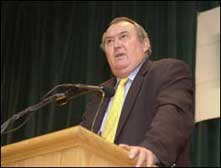 The presentation will be made by Dr Richard Leakey and is entitled "Wildlife management in East Africa – Is there a future?".
The lecture takes place at 7.30pm on Thursday 15 March 2007 at the Royal Geographic Society, 1 Kensington Gore, London SW7. Tickets will be £12, with a pay bar before and after the Lecture, and they are available now from www.savetherhino.org or Zoe at Save the Rhino, Email: zoe_AT_savetherhino.org.
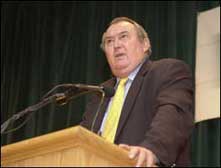 The presentation will be made by Dr Richard Leakey and is entitled "Wildlife management in East Africa – Is there a future?".
The lecture takes place at 7.30pm on Thursday 15 March 2007 at the Royal Geographic Society, 1 Kensington Gore, London SW7. Tickets will be £12, with a pay bar before and after the Lecture, and they are available now from www.savetherhino.org or Zoe at Save the Rhino, Email: zoe_AT_savetherhino.org.
Save the Rhino International and the Environmental Investigation Agency are co-hosting the Fifth Douglas Adams Memorial Lecture, a talk by Dr Richard Leakey, on Thursday 15 March at the Royal Geographic Society in London SW7. In this talk, Dr Leakey will draw on his own experiences in Kenya, as founder and Director of the Kenya Wildlife Service and as the Head of Kenya's Civil Service to reflect on the successes, current problems and future challenges.
Richard Erskine Leakey was born on 19 December 1944, the second of Louis and Mary Leakey's three sons. Quickly following in his parents’ footsteps, his first career was in the field of paleoanthropology, with many important finds including (with Alan Walker in 1984), "Turkana Boy," a Homo erectus roughly 1.6 million years old, one of the most complete skeletons ever found. In 1968, aged just 24, Richard Leakey was appointed Director of the National Museums of Kenya.
In 1989 Richard left his post to become Director of the Kenya Wildlife Service. In this capacity, he spearheaded efforts to end rampant elephant poaching, but he made political enemies in the process. Nonetheless, the elephant population has since stabilised and continues to grow. In 1993 Leakey survived a serious plane crash and the following year he resigned as director of the Kenya Wildlife Service, though he continues to be active in political and environmental arenas.
As the former Director of Kenya's National Museums and former director of the Kenya Wildlife Service, he has used his leadership skills and considerable influence to raise money for the preservation of Kenyan culture and wildlife. Never one to back down on a challenge, in 1995 Richard Leakey took a stand against corruption in Kenya’s government by forming Safina, an opposition party. Despite being subjected to beatings, death threats, and constant government surveillance, Leakey has continued his crusade for political justice. Although no longer active in fieldwork, Dr Leakey, as one of the foremost authorities on wildlife and nature conservation, continues to educate others about the dangers of environmental degradation through his many lectures and books.
The lecture is in aid of Save the Rhino International and the Environmental Investigation Agency, two charities supported by Douglas Adams. Douglas developed his deep-seated interest in wildlife conservation during a 1985 visit to Madagascar, which eventually resulted in a book (Last Chance to See) about the plight of species facing extinction. Douglas Adams died unexpectedly in 2001 at the age of 49. These Memorial Lectures continue to explore the themes in which Douglas was so interested.
Dr Leakey’s books include: Wildlife Wars: My Battle to Save Kenya's Elephants(paperback, August 2002, PanMacmillan, RRP £7.99); The Sixth Extinction: Biodiversity and Its Survival
with Roger Lewin (paperback, November 1996, Phoenix Press, RRP £7.99); and Origins Reconsidered: In Search of What Makes Us Human
also with Roger Lewin (paperback, October 1993, Abacus, RRP £10.99).
Douglas Adams created all the various and contradictory manifestations of The Hitchhiker’s Guide to the Galaxy: radio, novels, TV, film, computer games, stage adaptations, comic book and bath towel. For more information about Douglas Adams and his creations, please visit www.douglasadams.com
The Environmental Investigation Agency (EIA) is an international campaigning organisation committed to investigating and exposing environmental crime. Since 1984, EIA has used pioneering investigative techniques all over the world to expose the impact of environmental crime and to seek lasting solutions. More info at www.eia-international.org
Save the Rhino International works to conserve genetically viable populations of critically endangered rhinoceros species in the wild. We do this by providing financial and in-kind support for rhino- and community-based conservation projects in Africa and Asia. More info at www.savetherhino.org
Tickets are on sale now. Simply download the form and send it in with your cheque, alternatively phone the office on 0207 357 7474 and pay over the phone.

Friday, February 23, 2007
Audio: Single White Rhino Would Like To Meet
Maxton Walker's "Pick of the Day" in the Guardian is the two-part BBC Radio 4 series exploring the role of captive breeding programmes for endangered animals around the world - "Single White Rhino Would Like To Meet".
The first programme aired today (Friday 23 February 2007) at 11am and I assume part two will appear next week. Both shows should be available as internet streaming audio, live and On-Demand for at least 7 days following the broadcasts.
Part 1 should be available for streaming, but I am getting a "Sorry we can't bring you the programme you requested". Please leave a comment if you manage to listen to the show.
The first programme aired today (Friday 23 February 2007) at 11am and I assume part two will appear next week. Both shows should be available as internet streaming audio, live and On-Demand for at least 7 days following the broadcasts.
Part 1 should be available for streaming, but I am getting a "Sorry we can't bring you the programme you requested". Please leave a comment if you manage to listen to the show.
Rosamund Kidman-Cox explores the role of captive breeding programmes for endangered species operated by zoos worldwide and asks how they aid conservation in the wild. For all creatures, the management of the gene pool is a crucial part of any breeding programme and finding suitable mates is a complicated business.Thanks to Dave H for the tip
Rosamund visits Whipsnade Wild Animal Park to see how their herd of southern white rhinos has been growing over recent decades and what problems they have encountered. She also joins a female red panda at Bristol Zoo as she is introduced to her new mate.
Tuesday, February 20, 2007
Beyond ACTS: African Elephants in Ivory Wars
 A team-member at National Geographic magazine wrote to tell me about their Ivory Wars article in the March 2007 edition. It is about the elephants of Zakouma National Park in Chad, and the extreme poaching problems that they face. The story is also covered in some depth on the National Geographic magazine website, with Feature 1 - Ivory Wars and Feature 2 - Eye To Eye by J. Michael Fay plus photographs by Michael Nichols.
The dead elephant, a huge bull, lay on his side, right leg curled as if in wrenching pain. Dirt covered the exposed eye—magic done by poachers to hide the carcass from vultures. The smell of musth and urine, of fresh death, hung over the mound of the corpse. It was a sight I had seen hundreds of times in central Africa. As I passed my hand over his body from trunk to tail, tears poured down my cheeks. I lifted the bull's ear. Lines of bright red blood bubbled and streamed from his lips, pooling in the dust. His skin was checkered with wrinkles. The base of his trunk was as thick as a man's torso. Deep fissures ran like rivers through the soles of his feet; in those lines, I could trace every step he had taken during his 30 years of life.They also have an information page on their Google Earth feature, with the Zakouma—Ivory Wars KLM file ready to download into Google Earth.
Rich new layers let you zoom in on the park's animal inhabitants, read author Mike Fay's journal entries, see camera-trap photos, and more.Much like Jane Goodall's Chimpanzee Blog, the Ivory Wars Google Earth layer has (amongst other things) blog entries and lots of stunning photography. Combined with their previous Google Earth content such as the African Megaflyover, National Geographic truly are at the forefront of making the best use of this emerging "geo-browser".
Thanks to Keene Haywood for alerting me to the story, Mike Fay and Michael Nichols, and all the rest of the National Geographic team who worked on this story. I'm pleased to help spread the word about your good work.
P.S. As I've mentioned in a previous blog post, you can take Google Earth way beyond the basic mouse and keyboard control with 3D-Connexion's fabulous "Space Navigator". I highly recommended this intuitive, addictive and very attractively priced device. It makes exploring special layers like Ivory Wars even easier.
Thursday, January 25, 2007
Other Conservation: Baby Pandas Face a Hard Road Ahead
While we're on the subject of endangered animal babies, here's an interesting article at female oriented science site "Inkling Magazine" about the many recent panda births across the world's zoos - Baby Pandas Face a Hard Road Ahead
Ah! Here we go.... Whhhheeeeeeeeeeeeeeeeeeeeee!
But are giant pandas really bounding their way back from the brink of extinction, or are we just losing our minds in the midst of so much prime-time cuteness? The facts hold both promise and cause for concern.The article links to this cute video, which sadly fails to live up to its slippery potential...
Ah! Here we go.... Whhhheeeeeeeeeeeeeeeeeeeeee!
Subscribe to:
Posts (Atom)