GA4

Showing posts with label Dr Richard Leakey. Show all posts

Sunday, July 29, 2007

Richard Leakey on DR Congo's Gorilla slaughters

Newsweek on MSNBC.com has excerpts from an extensive interview with Dr. Richard Leakey in which he discusses the threat facing Congo gorillas and what the world can do to help. The feature also includes a slideshow of graphic images from the recent Mountain Gorilla killings which readers may find disturbing.
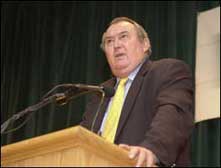
Richard Leakey is the founder of Wildlife Direct, a European Union-funded conservation organization based in Kenya and the Democratic Republic of the Congo (DRC), works to protect the apes in Virunga park. A renowned paleontologist, Leakey’s tough antipoaching measures are credited with putting an end to the elephant slaughter in Kenya in the 1980s. He spoke by phone from Kenya to NEWSWEEK’s Scott Johnson about the recent slaughter of some of the endangered animals, the threat posed by the charcoal industry and what the international community needs to do next.
Read on at MSNBC.com and in Newsweek magazine.

Friday, April 20, 2007

Mountain Gorillas: Video of newborn baby

A nice post over at the Gorilla Protection Blog includes an exclusive, albeit brief, video of 2-day old Mountain Gorilla which has yet to be named.
Check out more of Wildlife Direct's YouTube Videos including a contribution from Dr. Richard Leakey.

Friday, April 13, 2007

Fifth Douglas Adams Memorial Lecture - Video Report

On Thursday 15 March 2007, Dr Richard Leakey presented the Fifth Douglas Adams Memorial Lecture which was entitled "Wildlife management in East Africa – Is there a future?". Here's a video report as posted on YouTube.

Wednesday, March 28, 2007

Mountain Gorilla Roundup

Here's a quick roundup of some Mountain Gorilla links that have caught my eye recently.

Richard Leakey (presenter of the recent Fifth Douglas Adams Memorial Lecture) was interviewed for a National Geographic Podcast about the birth of an endangered Mountain Gorilla. The Gorilla Protection Blog commented on the interview.

The excellent Gorilla Protection Blog again with a post about "What Happens when Poachers Kill Mountain Gorillas?".

Opodo.co.uk with a report that the Ugandan Wildlife Authority has announced plans to bring two more mountain gorilla family groups into Bwindi National Park for eco-tourism purposes.

ThisIsLondon.co.uk with an extensive article about a Alcatraz style island for delinquent gorillas. Lots of great photos.
Will the crate be strong enough? I give it a rattle. Thick welded bars at the front, padlocks, a steel frame and 15 millimetre ply panels. Even Houdini wouldn't have stood a chance.

But Houdini did not weigh a quarter of a tonne, did not possess rippling muscles capable of throwing a grown man several feet into the air - and nor did he have the animal equivalent of an Asbo hanging over him. Even in his weakened state, the crate's inmate, Sid, is growing restless, and this most truculent and traumatised of beasts is capable of causing a lot of trouble.

Wednesday, March 07, 2007

Fifth Douglas Adams Memorial Lecture - Last Chance For Tickets!

According to the latest RhiNews Save The Rhino Newsletter...
There are still some tickets available for Dr Leakey's lecture on Thursday 15 March, in memory of Douglas Adams.

The lecture will be held at the Royal Geographic Society, South Kensington, London. Doors open at 6.45pm and the lecture starts at 7.30pm. Please book tickets in advance as we expect the Lecture to be fully sold out.
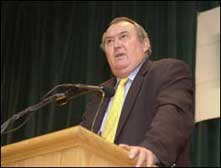
The presentation will be made by Dr Richard Leakey and is entitled "Wildlife management in East Africa – Is there a future?".

The lecture takes place at 7.30pm on Thursday 15 March 2007 at the Royal Geographic Society, 1 Kensington Gore, London SW7. Tickets will be £12, with a pay bar before and after the Lecture, and they are available now from www.savetherhino.org or Zoe at Save the Rhino, Email: zoe_AT_savetherhino.org.

For more information, see our previous post on the Lecture.

Friday, March 02, 2007

Mountain Gorillas: Baby born last month

CBS.com is one of many sites covering the news that a baby Mountain Gorilla was born in Congo on Februry 17th. Hurray!
The tiny gorilla, named Ndeze, was born Feb. 17 in Congo's Virunga National Park, home to some of the world's last 700 mountain gorillas, said Samantha Newport of the conservation support group WildlifeDirect

"It's incredibly positive. These gorillas have managed to survive a 10-year civil war," Newport told The Associated Press by telephone from the park. It is "an absolute miracle and testament to the work of the rangers, who worked throughout the war without receiving a salary, and to conservationists from all over the world."
Richard Leakey, the conservationist credited with helping end the slaughter of elephants in Kenya during the 1980s, is also quoted in the article. He will be hosting the Fifth Douglas Adams Memorial Lecture on March 15th.
"The Mountain Gorillas have been under enormous pressure for many years, and a newborn is always a positive step toward protecting these animals," Leakey said. "We should not forget that this is the product of enormous effort and sacrifice on the part of African rangers, many of whom have paid the price of this success with their lives."

Saturday, February 24, 2007

Fifth Douglas Adams Memorial Lecture

Reminder! The Fifth Douglas Adams Memorial Lecture takes place on March 15th 2007.

The presentation will be made by Dr Richard Leakey and is entitled "Wildlife management in East Africa – Is there a future?".

The lecture takes place at 7.30pm on Thursday 15 March 2007 at the Royal Geographic Society, 1 Kensington Gore, London SW7. Tickets will be £12, with a pay bar before and after the Lecture, and they are available now from www.savetherhino.org or Zoe at Save the Rhino, Email: zoe_AT_savetherhino.org.
Save the Rhino International and the Environmental Investigation Agency are co-hosting the Fifth Douglas Adams Memorial Lecture, a talk by Dr Richard Leakey, on Thursday 15 March at the Royal Geographic Society in London SW7. In this talk, Dr Leakey will draw on his own experiences in Kenya, as founder and Director of the Kenya Wildlife Service and as the Head of Kenya's Civil Service to reflect on the successes, current problems and future challenges.

Richard Erskine Leakey was born on 19 December 1944, the second of Louis and Mary Leakey's three sons. Quickly following in his parents’ footsteps, his first career was in the field of paleoanthropology, with many important finds including (with Alan Walker in 1984), "Turkana Boy," a Homo erectus roughly 1.6 million years old, one of the most complete skeletons ever found. In 1968, aged just 24, Richard Leakey was appointed Director of the National Museums of Kenya.

In 1989 Richard left his post to become Director of the Kenya Wildlife Service. In this capacity, he spearheaded efforts to end rampant elephant poaching, but he made political enemies in the process. Nonetheless, the elephant population has since stabilised and continues to grow. In 1993 Leakey survived a serious plane crash and the following year he resigned as director of the Kenya Wildlife Service, though he continues to be active in political and environmental arenas.

As the former Director of Kenya's National Museums and former director of the Kenya Wildlife Service, he has used his leadership skills and considerable influence to raise money for the preservation of Kenyan culture and wildlife. Never one to back down on a challenge, in 1995 Richard Leakey took a stand against corruption in Kenya’s government by forming Safina, an opposition party. Despite being subjected to beatings, death threats, and constant government surveillance, Leakey has continued his crusade for political justice. Although no longer active in fieldwork, Dr Leakey, as one of the foremost authorities on wildlife and nature conservation, continues to educate others about the dangers of environmental degradation through his many lectures and books.

The lecture is in aid of Save the Rhino International and the Environmental Investigation Agency, two charities supported by Douglas Adams. Douglas developed his deep-seated interest in wildlife conservation during a 1985 visit to Madagascar, which eventually resulted in a book (Last Chance to See) about the plight of species facing extinction. Douglas Adams died unexpectedly in 2001 at the age of 49. These Memorial Lectures continue to explore the themes in which Douglas was so interested.


Dr Leakey’s books include: Wildlife Wars: My Battle to Save Kenya's Elephants (paperback, August 2002, PanMacmillan, RRP £7.99); The Sixth Extinction: Biodiversity and Its Survival with Roger Lewin (paperback, November 1996, Phoenix Press, RRP £7.99); and Origins Reconsidered: In Search of What Makes Us Human also with Roger Lewin (paperback, October 1993, Abacus, RRP £10.99).

Douglas Adams created all the various and contradictory manifestations of The Hitchhiker’s Guide to the Galaxy: radio, novels, TV, film, computer games, stage adaptations, comic book and bath towel. For more information about Douglas Adams and his creations, please visit www.douglasadams.com

The Environmental Investigation Agency (EIA) is an international campaigning organisation committed to investigating and exposing environmental crime. Since 1984, EIA has used pioneering investigative techniques all over the world to expose the impact of environmental crime and to seek lasting solutions. More info at www.eia-international.org

Save the Rhino International works to conserve genetically viable populations of critically endangered rhinoceros species in the wild. We do this by providing financial and in-kind support for rhino- and community-based conservation projects in Africa and Asia. More info at www.savetherhino.org

Tickets are on sale now. Simply download the form and send it in with your cheque, alternatively phone the office on 0207 357 7474 and pay over the phone.

Tuesday, November 21, 2006

Fifth Douglas Adams Memorial Lecture

Details have been announced for the Fifth Douglas Adams Memorial Lecture. The presentation will be made by Dr Richard Leakey and is entitled "Wildlife management in East Africa – Is there a future?".

The lecture takes place at 7.30pm on Thursday 15 March 2007 at the Royal Geographic Society, 1 Kensington Gore, London SW7. Tickets will be £12, with a pay bar before and after the Lecture, and they are available now from www.savetherhino.org or Zoe at Save the Rhino, Email: zoe_AT_savetherhino.org.
Save the Rhino International and the Environmental Investigation Agency are co-hosting the Fifth Douglas Adams Memorial Lecture, a talk by Dr Richard Leakey, on Thursday 15 March at the Royal Geographic Society in London SW7. In this talk, Dr Leakey will draw on his own experiences in Kenya, as founder and Director of the Kenya Wildlife Service and as the Head of Kenya's Civil Service to reflect on the successes, current problems and future challenges.

Richard Erskine Leakey was born on 19 December 1944, the second of Louis and Mary Leakey's three sons. Quickly following in his parents’ footsteps, his first career was in the field of paleoanthropology, with many important finds including (with Alan Walker in 1984), "Turkana Boy," a Homo erectus roughly 1.6 million years old, one of the most complete skeletons ever found. In 1968, aged just 24, Richard Leakey was appointed Director of the National Museums of Kenya.

In 1989 Richard left his post to become Director of the Kenya Wildlife Service. In this capacity, he spearheaded efforts to end rampant elephant poaching, but he made political enemies in the process. Nonetheless, the elephant population has since stabilised and continues to grow. In 1993 Leakey survived a serious plane crash and the following year he resigned as director of the Kenya Wildlife Service, though he continues to be active in political and environmental arenas.

As the former Director of Kenya's National Museums and former director of the Kenya Wildlife Service, he has used his leadership skills and considerable influence to raise money for the preservation of Kenyan culture and wildlife. Never one to back down on a challenge, in 1995 Richard Leakey took a stand against corruption in Kenya’s government by forming Safina, an opposition party. Despite being subjected to beatings, death threats, and constant government surveillance, Leakey has continued his crusade for political justice. Although no longer active in fieldwork, Dr Leakey, as one of the foremost authorities on wildlife and nature conservation, continues to educate others about the dangers of environmental degradation through his many lectures and books.

The lecture is in aid of Save the Rhino International and the Environmental Investigation Agency, two charities supported by Douglas Adams. Douglas developed his deep-seated interest in wildlife conservation during a 1985 visit to Madagascar, which eventually resulted in a book (Last Chance to See) about the plight of species facing extinction. Douglas Adams died unexpectedly in 2001 at the age of 49. These Memorial Lectures continue to explore the themes in which Douglas was so interested.


Dr Leakey’s books include: Wildlife Wars: My Battle to Save Kenya's Elephants (paperback, August 2002, PanMacmillan, RRP £7.99); The Sixth Extinction: Biodiversity and Its Survival with Roger Lewin (paperback, November 1996, Phoenix Press, RRP £7.99); and Origins Reconsidered: In Search of What Makes Us Human also with Roger Lewin (paperback, October 1993, Abacus, RRP £10.99).

Douglas Adams created all the various and contradictory manifestations of The Hitchhiker’s Guide to the Galaxy: radio, novels, TV, film, computer games, stage adaptations, comic book and bath towel. For more information about Douglas Adams and his creations, please visit www.douglasadams.com

The Environmental Investigation Agency (EIA) is an international campaigning organisation committed to investigating and exposing environmental crime. Since 1984, EIA has used pioneering investigative techniques all over the world to expose the impact of environmental crime and to seek lasting solutions. More info at www.eia-international.org

Save the Rhino International works to conserve genetically viable populations of critically endangered rhinoceros species in the wild. We do this by providing financial and in-kind support for rhino- and community-based conservation projects in Africa and Asia. More info at www.savetherhino.org

Tickets are on sale now. Simply download the form and send it in with your cheque, alternatively phone the office on 0207 357 7474 and pay over the phone.