Here's a video clip / slideshow of Faust the Komodo Dragon at The Shedd Aquarium in Chicago.
Thursday, July 13, 2006

KOMODO DRAGONS - Ninki-Nanka and the Monster Detectives
An interesting story from the Independent Online about the "Ninki-Nanka", a mythical, 30 foot giant reptile that is supposed to dwell in the mangrove swamps of the Gambian jungle.
Once, the komodo dragon was thought to exist only in folklore. What other mythical beasts might we find if we look hard enough? Helen Brown meets the man on the trail of the ninki-nanka...Full story at the Independent Online.
[...]
The "dragon" is rumoured to look rather like a game of zoological "consequences", possessing the body of a crocodile, the neck of a giraffe and the head of a horse with three horns. Less fantastically, the team's leader, Richard Freeman of the Centre for Fortean Zoology, suspects the ninki-nanka of being a species of colossal monitor lizard. "Whatever the truth," he says, "this is the first dedicated expedition to search for this animal."
GREAT GORILLA RUN 2006 - Edinburgh, July 16th
**REMINDER**
Edinburgh's Great Gorilla Run takes place on Sunday, July 16th. Here's the Scotsman Online's coverage that we posted last month. The London Great Gorilla Run takes place on 24th September.THEY are usually spotted in the mist-covered mountains of Africa.Here's the link to the official Great Gorilla Run website with links to application pages for the Edinburgh Great Gorilla Run (16th July 2006) and London Great Gorilla Run (24th September 2006).
But hundreds of gorillas will be seen in the unlikely setting of Holyrood Park this summer.
For around 400 runners, all clad in gorilla suits, are to take part in Edinburgh's first Great Gorilla Run.
The run was launched in memory of murdered scientist Dian Fossey, whose story was immortalised in 1980s film Gorillas in the Mist.
Wednesday, July 12, 2006
AYE-AYE LEMURS - Final Chance To Save
The second series of the TV series with the disconcertingly familiar name of "Final Chance To Save" has begun airing on the Sky TV network in the UK, Fridays at 8pm. The series features various celebrities making trips around the world to visit endangered animals.
One of the shows features talented actress Miranda Richardson (Blackadder) on a visit to Madagascar to visit the Aye-Aye Lemurs.
Sky One - Friday 21st July, 8pm
Sky Two - Saturday 22nd July, 7pm
The series also features a Gorilla visit from mountaineer Joe Simpson, who experienced and wrote about his harrowing mountain adventure in "Touching the Void ".
".
Other endangered animals visited in this series include Jaguars (Comedian Bill Bailey) and Tigers (Sanjeev Bhaskar).
No word on a US broadcast of the "Final Chance To Save" series, nor of any potential DVD release.
One of the shows features talented actress Miranda Richardson (Blackadder) on a visit to Madagascar to visit the Aye-Aye Lemurs.
Madagascar, one of the world's last great wildernesses and home to 530 of the world's most endangered species, is home to the Aye-Aye, a creature that famously inspired Tolkien's Gollum from the Lord of the Ring's trilogy. Thought to be extinct in 1961, the Aye-Aye, a primate like us and a close evolutionary relative, was rediscovered and for the last four decades it has been on the world's most endangered list. If we don'’t act now, we could lose the species Miranda describes as the '‘underdog'’ of the natural world.Dave Haddock reports that the Miranda Richardson/Aye-Aye episode show airs on:
Sky One - Friday 21st July, 8pm
Sky Two - Saturday 22nd July, 7pm
The series also features a Gorilla visit from mountaineer Joe Simpson, who experienced and wrote about his harrowing mountain adventure in "Touching the Void
".Other endangered animals visited in this series include Jaguars (Comedian Bill Bailey) and Tigers (Sanjeev Bhaskar).
No word on a US broadcast of the "Final Chance To Save" series, nor of any potential DVD release.
Tuesday, July 11, 2006
SIERRA CLUB INSIDERS - A warm welcome!
A very warm welcome to Sierra Club members! I'm very honoured to have been included in your Sierra Club Insider newsletter. I hope you enjoy your visit here, and please do subscribe to our RSS feed.
This website will be getting a bit of a makeover at the end of July to celebrate our second birthday, so do stay tuned! And if you haven't yet read "Last Chance To See", I heartily recommend it. A great book! See the links in the sidebar for more details.
This website will be getting a bit of a makeover at the end of July to celebrate our second birthday, so do stay tuned! And if you haven't yet read "Last Chance To See", I heartily recommend it. A great book! See the links in the sidebar for more details.
Monday, July 10, 2006
KAKAPO PARROTS - 86 or 87?
I've finally put the mystery of the Kakapo numbers to bed. A contact at the Stewart Island Visitor Center sent me a lovely email which answers a question that has been bugging me for a while - Do we have 86 or 87 Kakapo Parrots?
In 2004 the number of Kakapo Parrots stood at 86. Unfortunately, 3 birds (Aroha, Vollie and Aurora) died from a bacterial infection (Erysipelas) leaving just 83 birds.
Then widespread delight in 2005 when 4 chicks were successfully hatched - F1 and F2 from Flossie, MM2 from Margaret-Maree, and S1 from Sarah. That brought us up to 87. Or so we thought.
Turns out, that in 2005, an adult bird (Gunner) died from fungal toxins, leaving the current population back at 86 (41 females, 45 males).
So there we go. 86 it is! Mystery solved. 2006 was not a successful breeding season, so let's hope for better luck in 2007.
More information (as ever) at The Kakapo Recovery Programme website.
In 2004 the number of Kakapo Parrots stood at 86. Unfortunately, 3 birds (Aroha, Vollie and Aurora) died from a bacterial infection (Erysipelas) leaving just 83 birds.
Then widespread delight in 2005 when 4 chicks were successfully hatched - F1 and F2 from Flossie, MM2 from Margaret-Maree, and S1 from Sarah. That brought us up to 87. Or so we thought.
Turns out, that in 2005, an adult bird (Gunner) died from fungal toxins, leaving the current population back at 86 (41 females, 45 males).
So there we go. 86 it is! Mystery solved. 2006 was not a successful breeding season, so let's hope for better luck in 2007.
More information (as ever) at The Kakapo Recovery Programme website.
Sunday, July 09, 2006
LEMURS - Three new lemur species discovered
MSNBC is one of many outlets that reported the discovery of three new species of mouse lemur recently. Here's one of the new primates, the Microcebus Mittermeieri...
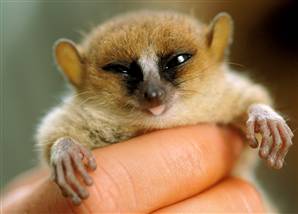

Picture by Mark Thiessen / National Geographic Society
Famed for its lemurs, Madagascar now has three new species of the shy primates.Full article at MSNBC.com
The three new mouse lemurs were officially named in a paper published in June by the International Journal of Primatology and announced at a conservation conference on Wednesday in the Malagasy capital.
Subscribe to:
Posts (Atom)